Every second year there’s a global get-together for all those interested in the promotion of cycling. Transportation experts, mayors, town councillors, consultants for ‘liveable cities’, documentary film-makers -and of course cycling advocates- attend the Vélo-city Global Conference.
The European Cycling Federation organises the event, and this year it was held in Taipei, Taiwan. VéloCity Global alternates with the European-focussed VéloCity Conference. Next year this event will be in Nijmegen, Holland – the home of cycling for entirely different reasons, and the next VéloCity Global will be in Rio de Janeiro. read more »
Submission to Nelson City Council on Long Term Plan 2015-25
April 2015
Dear Nelson City Council,
Thank you for the opportunity to make a submission on the important topic of the Long Term Plan. I write, in a personal capacity, as an urban designer, architect, and resident of Stoke.
Introduction
‘Physical inactivity is the new smoking’, health promotion specialists are now saying1. Almost 1 in 3 New Zealand adults are obese, and a further 34% are overweight2.
Meanwhile, 49% of Kiwis’ trips to work are 5km or less3 -easily short enough to be done by bike- but 74% of work trips are done by car. The figures for Nelson are not much better, and tragically, the statistics for our kids’ journeys to school are just as bad.
So the effective promotion of cycling, and active transport in general, is a critically urgent priority for Nelson.
Below are comments relating to the five main headings suggested by the Consultation Document- read more »
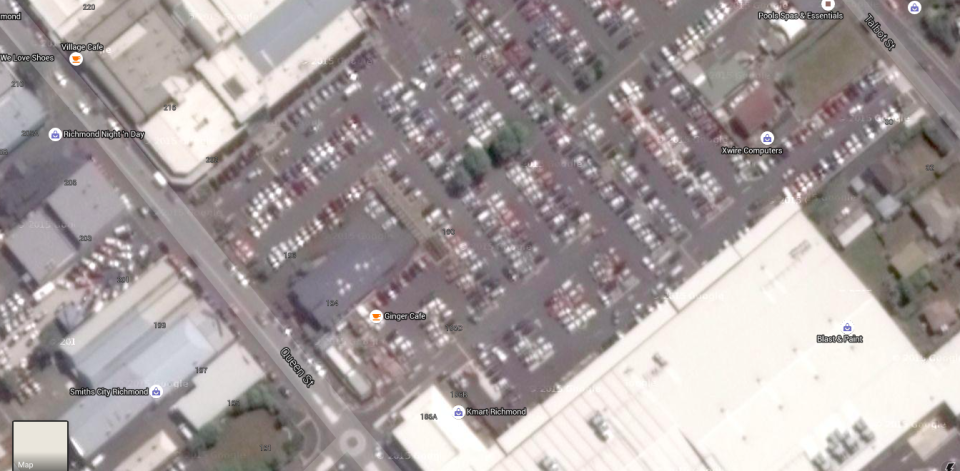
Above photo shows central Richmond, largest town in Tasman District Council. At bottom left is entrance to Tasman District Council, adjacent to the recently installed roundabout.
My submission
is that Tasman District Council must begin, particularly in the larger towns such as Richmond, to switch from facilitating development based on suburban sprawl, to more high-density development, ultimately to building types such as three-storey townhouse developments and mixed-use retail/residential schemes.
Higher density living and working has been shown internationally to allow better use of all our resources, from water to transport. It will particularly facilitate the accommodation of an increased population and the quality of life of an older cohort of residents, who need to live close to local facilities and services and often are less able to drive independently.
In the context of major construction works in the central city to accommodate a new tram line, Luas Cross City, the 2015 Dublin Transport Study made several progressive proposals. I’ve made the following personal submission. read more »
Submission to Ministry for the Environment regarding climate change target
CAN is deeply concerned about climate change.
CAN strongly supports evidence-based decision-making, and the evidence available strongly supports robust action.
CAN is concerned that the current Ministry for the Environment discussion document calculates the cost of action on climate change, but fails to set out the far higher costs of taking little or no action, which is the current national policy.
Excellent infographic from Tracey Solicitors showing the dramatic increase in use of DublinBikes hire bikes, and increases in cycling mode choice in Dublin County generally.
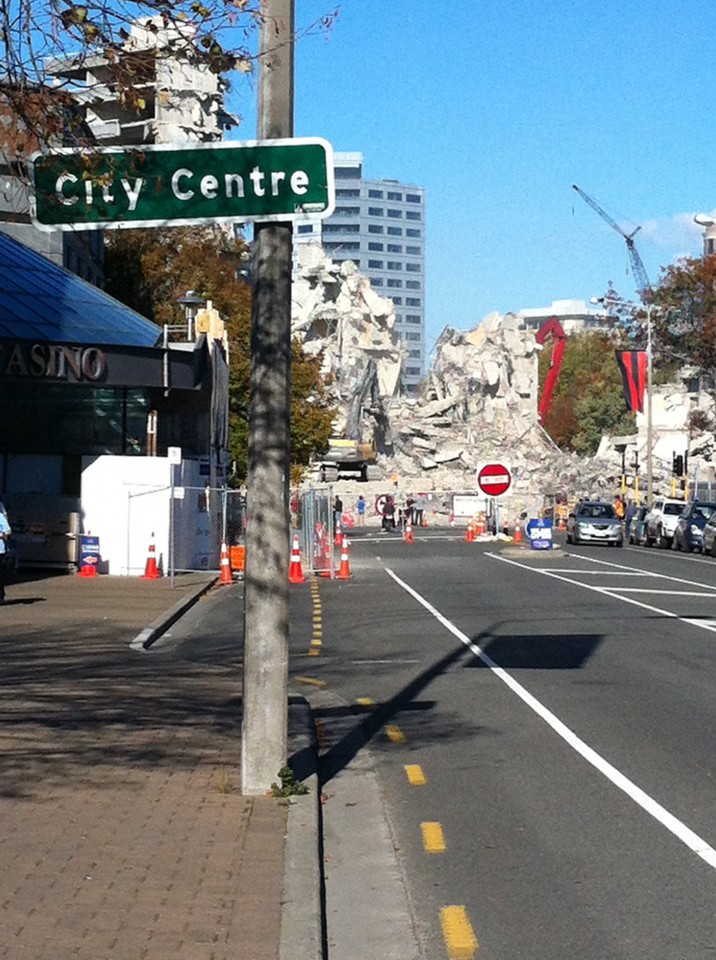
Christchurch centre under demolition, 2012- April 21st
Christchurch City Council has reportedly considered a restructure of its system of charging house-builders levies when granting consent to build. Levies for building in rural areas may increase, while higher-density developments nearer the city centre would be charged less.
Development contributions are gathered to help fund Council expenditure like drainage, water supply, roads and parks.
In the interests of reducing car-dependence and increasing active travel, as well as perhaps encouraging more socially inclusive living spaces, the adoption of this sort of measure by Councils looks like good thinking.
Text of Radio NZ article, downloaded 2014 November 11th, follows-
The change is proposed in a report going to the council this week under which developers will pay more for the costs the council incurs in providing roads and sewerage to service new subdivisions.
Up until now, development contributions have mostly been at a flat rate, regardless of the amount of new infrastructure a subdivision may require.
A change to the Local Government Act earlier this year asked that councils apply more of a user pays-type model, charging developers in so-called greenfields areas where infrastructure is non-existent, more than those in brown fields areas, where roads and sewerage are already in place.
Property Council spokesman Connal Townsend, representing property developers, said while the new formula would increase prices for green fields housing, the cost of brown fields homes should come down.
Mr Townsend said the proposal was fairer and more transparent.
In Christchurch, the maximum amount a developer could be charged in a green fields area would increase 30 percent, from $45,000 to just under $60,000.
Mr Townsend said while the change would help meet the council's aim of moving development away from green fields areas to brown fields locations, it should not be used as a tool to help meet the council's planning objectives.
"I have a real anxiety about trying to use changes to development contributions policies to try to encourage particular types of development that might appeal to local planners," he said.
"I think that's an extremely dangerous approach. The best way to view it is that the actual true cost of the infrastructure needed for the development be part of the development contribution. And that should be the beginning and the end of it."
Gary Garner, a senior lecturer in property studies at Lincoln University, said it remained to be seen if a proposal to further discount development contributions for those building apartments would encourage more intensive housing.
"In the bigger picture of things, if you're talking about what will make a difference for individual property development projects, to me it's the macro-economic policy, rather than these micro issues that are going to make the biggest single difference."
But Mr Garner said any movement towards bringing down the cost of housing had to be welcomed.
The proposed changes to development contributions need to be signed off by the council by the end of the month and will be consulted on as part of the Long term Plan early next year.
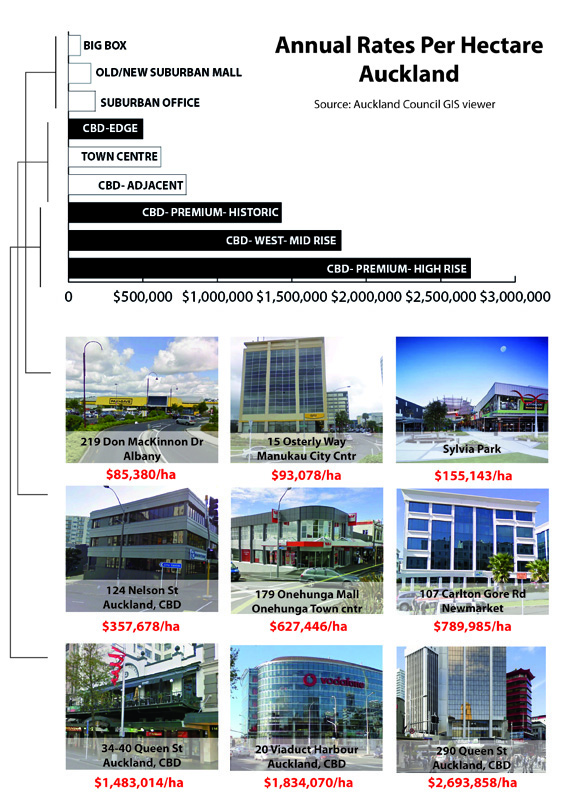
Posted on Auckland Transport Blog, October 2014, it looks at the strange relationship between politically conservative and suburban sprawl. Link here.
Headed, ‘Want Lower Rates? Cut Back on Urban Sprawl’, it makes some good points about the affordability for local authorities of the infrastructure for low-density development.
NZ Cycle Safety Panel -Draft Report for Consultation
The New Zealand Transport Agency have convened a high-level panel of experts, chaired by Richard Legget of Bike NZ and NZ Post, who have in September 2014 released their draft report on cycle safety. Here are a few thoughts which I am submitting to them for consideration.
Click on image for PDF version (0.08 Mb)
Key points
Significant increases in cycling and walking -as distinct from safe cycling among existing cyclists- is extremely urgent for Kiwis’ health.
The Report is highly commendable in its thinking and recommendations.
It doesn’t have the mandate to recommend all the necessary promotional measures -legal, educational, infrastructural, etc.- to get more Kiwis on bikes.
Its most useful recommendation is that high-level leadership is needed -but that should be for the promotion of increased cycling generally, not just for safety of existing cyclists.
A higher-level body than the NZTA should be responsible for this promotion, ideally an inter-departmental body, implementing a considered and detailed national policy with adequate funding and realistic timelines.
The detailed recommendations of the Report relating to road safety are generally excellent. Legislation for safe overtaking clearances and lower speed limits would be very welcome for New Zealand cyclists.







 HorseBike-1
 Hello
Hello