


How is it to cycle in San Francisco? Are the size and resources of the SFBC reflected in an ordinary cyclist’s experience on the ground!?
These are subjective impressions. My experience of cycling in SF includes working as a courier in the downtown area over 20 years ago, brief cycling visits since, and anecdotes from many cycling friends. During this June, 2013 visit I biked about 100km in most parts of the city by bike, on social, business, leisure/exercise and household trip –also using public transport, car and motorcycle.
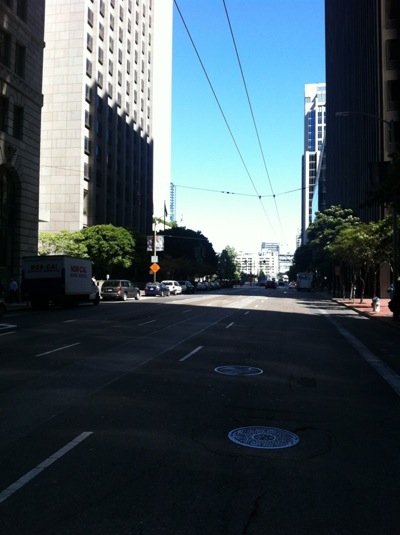
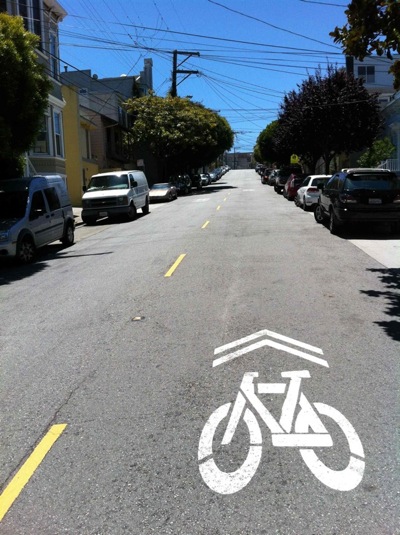
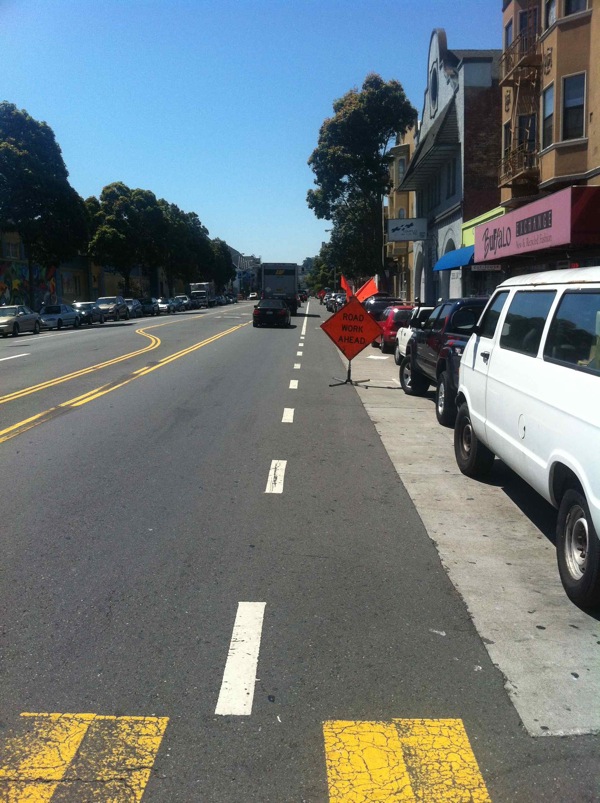
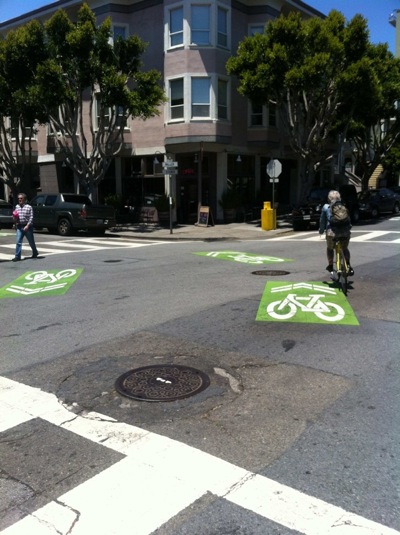
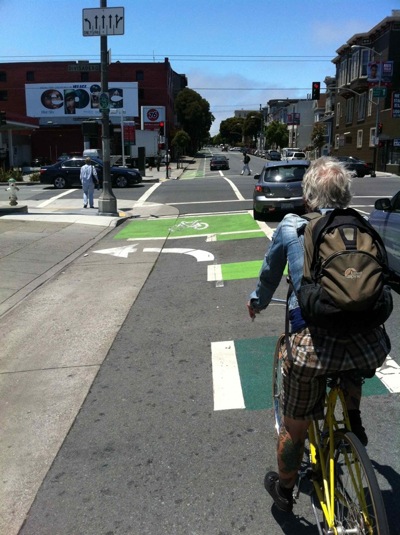
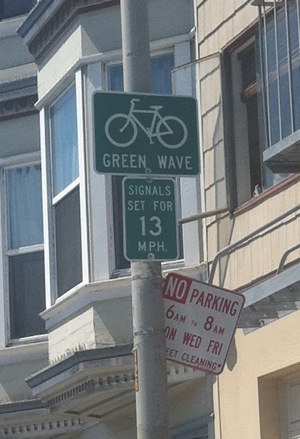
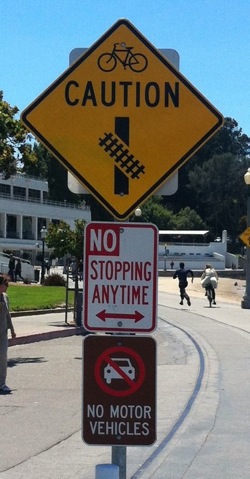
My impression is that cycling in San Francisco has been greatly facilitated by infrastructure both of what I’d term ‘first generation’ type e.g. discontinuous roadside cycle lanes, and of more advanced type i.e. separated or shared but carefully designed infrastructure. See photos & captions for some examples.
- Cyclists are frequently guided by the infrastructure to command a lane or use a shared surface, for example continuing straight where motor vehicles are changing lanes to turn.
- More importantly, motorist behaviour is noticeably better than Dublin’s, and I am sure it has improved in recent years. Motorists are very courteous to both pedestrians and cyclists. My impression is that this results from both ‘road-use culture’ i.e. prevailing etiquette, and of a level and efficiency of enforcement unheard of in Ireland. It is also the result of vastly increased cycling numbers, and obvious official support (more effective than the low budget allocation would imply) for cycling.
- Motorists consistently yield to pedestrians at junctions where a pedestrian, carrying straight across the side-road, has right of way. (also law in Dublin but perennially ignored)
- Why behaviour is more friendly isn’t apparent. Comparison with behavioural changes in Dublin subsequent to the intensive use of the Dublin Bikes rental system might be useful. If a bike-share scheme is to be introduced in SF, some measurement of road-use habits on before-and-after basis would be valuable.
- Turning right on a red light is permitted in California for both motorists and cyclists under certain circumstances. I observed cyclists routinely breaking red lights in all directions, however; enforcement of rules around this practice seemed to be minimal –a familiar story.
- The ‘Four-way stop’ junction type (cross-roads with stop signs at each arm) is common, and motorists will stay stopped and yield to a moving cyclist, even where strictly it’s the cyclist who should wait; evidently non-observance by cyclists has created a de facto regime or etiquette to the benefit of cyclists. Stop sign observance by motorists is rigidly and effectively enforced by police. The need for eye contact or other communication at these junctions is interesting in the context of ‘shared space’ ideas.
- Passing clearance distances are not specified in law (a ‘3-foot’ State bill was rejected by Governor Brown last autumn) but the vast majority of motorists tend to allow 1.5 m or more. I wasn’t aggressively ‘swiped’ during a month of regular cycling.
- The SFBC seek separated bike lanes, but it’s currently impossible to get around the City without mixing with motor traffic. Certain routes (either provided with cycle lanes, or more lightly trafficked) must be picked to avoid hostile streets –see below.
- No HGV limitations are enforced on city streets, and very large/wide private vehicles especially pick-up trucks have proliferated.
- Footpath cycling is illegal for those aged over 13.
- No roundabouts! Returning to cycling in New Zealand it struck me how much stress these cause.
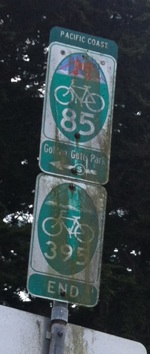
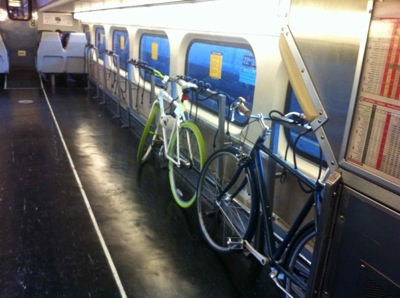
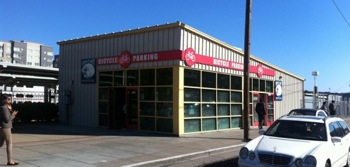
- Inter-modal travel is facilitated by significant investment in parking, signage, ticketing and bike space on buses and trains. The inter-suburban ‘Caltrain’ has a car dedicated to bikes; intra-urban buses have racks at front, and the underground BART train accommodates bikes in passenger cars at off-peak times and provides secure parking for bikes.
- There’s a mix of bike types on the streets. Dominant is a large-wheeled, simple ‘town bike’ style, like a messenger’s bike made comfortable & practical, often with flat handlebars, mudguards and a front rack. Dutch-style or High Nelly bikes, mountain bikes, and folding bikes are less common.
- Theft is a big problem –everyone has a story of their stolen bike.
- Parking has been provided (steel Sheffield-type stands, though shorter) on a widespread basis by the City, generally on footpaths.
Summary note-
Much has been done in SF to adapt a car-centric environment to make it bikeable. Though direct comparison’s impossible, I feel the transportation cyclist gets perceptibly better ‘level of service’ in SF than Dublin; there has been a strong push through the 2000’s to build lanes, convert public transport, and improve road use etiquette. A huge factor is the courtesy of motorists, which is not referred to very often in SFBC documents & needs further study. Deliberately hostile motoring wasn’t encountered at all during my visit.
A significant difference is that navigating the city on a bike entails identifying which routes have been selected for cyclists by officialdom. On-street experience rapidly reveals where these are. A consistent strategy is apparent: the vision of a network of bikeable routes in a car-friendly city is being resolutely followed. This vision may be comparable to the NTA’s policy for Dublin. As a basic level of service for transportation cycling, it does work. It reduces car dependence indirectly rather than confronting it.
 Hello
Hello